
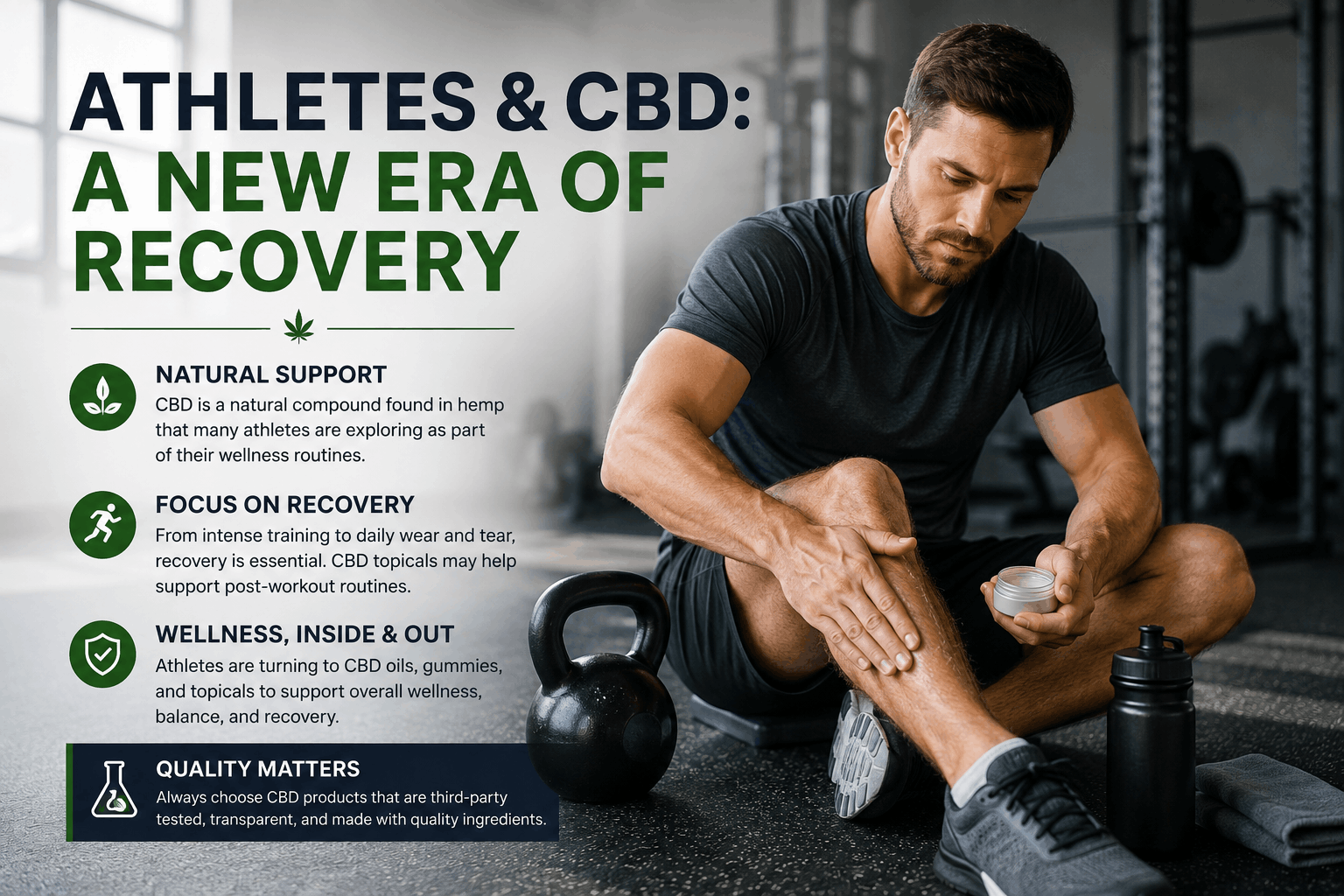
For athletes, training is only half the equation.
What happens after a workout can be just as important as the workout itself. Sleep, nutrition, hydration, stretching and adequate recovery time all play a role in helping the body prepare for the next training session.
In recent years, another product has increasingly entered the recovery conversation: CBD.
From professional competitors to recreational runners and weekend gym enthusiasts, athletes have become increasingly interested in cannabidiol and how hemp-derived products might fit into their overall wellness routines.
Why CBD Attracted the Attention of Athletes
CBD, or cannabidiol, is one of the naturally occurring compounds found in hemp.
Unlike THC, CBD does not produce the intoxicating “high” traditionally associated with marijuana. That distinction has helped CBD become increasingly visible within the mainstream wellness and fitness industries.
One major turning point for competitive sports came when the World Anti-Doping Agency removed cannabidiol from its list of prohibited substances in 2018.
That didn’t mean athletes suddenly had a new performance-enhancing substance. Instead, it meant CBD itself was no longer prohibited under WADA’s rules.
Importantly, other cannabinoids—including THC—remain prohibited in competition above applicable thresholds, so competitive athletes still need to be extremely careful about the products they use.
Professional Athletes Have Helped Bring CBD Into the Mainstream
CBD’s profile has also increased because a number of well-known athletes have publicly discussed or become involved with CBD.
Former NFL tight end Rob Gronkowski publicly discussed CBD after retiring from football and later partnered with a CBD company.
Former UFC fighter Nate Diaz also famously brought CBD into the sports conversation when he discussed using a CBD product following a fight in 2016.
Other current and former professional athletes have invested in, endorsed or publicly discussed CBD and cannabis-related wellness products.
These high-profile examples have helped move the CBD conversation beyond traditional cannabis culture and into the much larger world of sports, fitness and recovery.
Recovery Is Becoming a Bigger Part of Fitness
One reason CBD fits naturally into today’s fitness culture is that attitudes toward recovery have changed.
Years ago, many athletes focused primarily on training harder.
Today, recovery itself has become an industry.
Massage guns, compression equipment, cold plunges, saunas, mobility programs, specialized supplements and sophisticated sleep tracking are all examples of how seriously athletes now take the time between workouts.
CBD products have become another category people are investigating.
Some consumers prefer CBD oils or gummies, while athletes interested in localized application may gravitate toward CBD creams, salves and balms.
People interested in understanding the differences between these products can learn more about CBD and recovery along with CBD potency, topical products, ingredients, research and other frequently asked questions before deciding whether CBD belongs in their wellness routine.
Why Topical CBD Appeals to Active People
Topical products have an obvious advantage for athletes: they can be applied directly to a particular area of the body.
CBD creams and salves are commonly applied after workouts to areas such as the knees, shoulders, hands, feet and lower back.
Many topical formulations also combine CBD with familiar ingredients such as menthol and botanical extracts.
This creates an important distinction.
The sensation someone experiences after applying a cooling CBD cream, for example, isn’t necessarily coming exclusively from CBD. Menthol itself creates a recognizable cooling sensation.
That’s one reason consumers should look beyond the amount of CBD advertised on the front of the container and examine the entire formulation.
CBD Strength Can Vary Dramatically
Another development in the CBD market has been the emergence of increasingly concentrated products.
Early CBD topicals frequently contained relatively modest amounts of cannabidiol.
Today, consumers can find creams and salves containing several thousand milligrams of CBD, with some specialty high-potency formulations containing considerably more.
But a larger number doesn’t automatically mean a product is appropriate for everyone.
Container size matters.
Ingredients matter.
The type of hemp extract matters.
Third-party testing matters.
Consumers should consider all of these factors rather than judging a CBD product solely by the largest number printed on its label.
Competitive Athletes Need to Be Particularly Careful
Although CBD itself is not prohibited by WADA, competitive athletes should understand an important risk.
CBD products are derived from hemp, and some products may contain other cannabinoids—including THC.
There is also the possibility of inaccurate labeling or contamination in poorly manufactured products.
That makes independent laboratory testing particularly important for athletes subject to drug testing.
A certificate of analysis can help consumers evaluate cannabinoid concentrations and determine whether the laboratory results correspond with what’s represented on the product label.
Elite athletes should also check the rules of their individual sport or governing organization before using cannabinoid products.
What Does the Research Say?
Despite CBD’s popularity, consumers should keep expectations realistic.
Researchers continue to investigate CBD and its potential applications, but many of the claims surrounding CBD have moved faster than the scientific evidence.
That distinction is especially important when discussing athletic recovery.
CBD shouldn’t be viewed as a substitute for proper medical treatment, physical therapy, adequate sleep, good nutrition or appropriate recovery following an injury.
Instead, consumers interested in CBD should approach it the same way they would any other wellness product: research the ingredients, understand the limitations and speak with a qualified healthcare professional when appropriate.
The Future of CBD in Fitness
Whether CBD becomes a permanent fixture in athletic recovery remains to be seen, but its presence in the fitness industry demonstrates a larger change in how people think about taking care of their bodies.
Athletes aren’t simply looking for ways to train harder anymore.
They’re paying greater attention to sleep, mobility, nutrition, stress management and recovery.
CBD has become one part of that broader conversation.
And as more athletes become interested in hemp-derived wellness products, education will remain important.
Understanding what CBD is—and just as importantly, what it isn’t—allows athletes and everyday consumers to make better-informed decisions about whether it deserves a place in their own recovery routine.
